
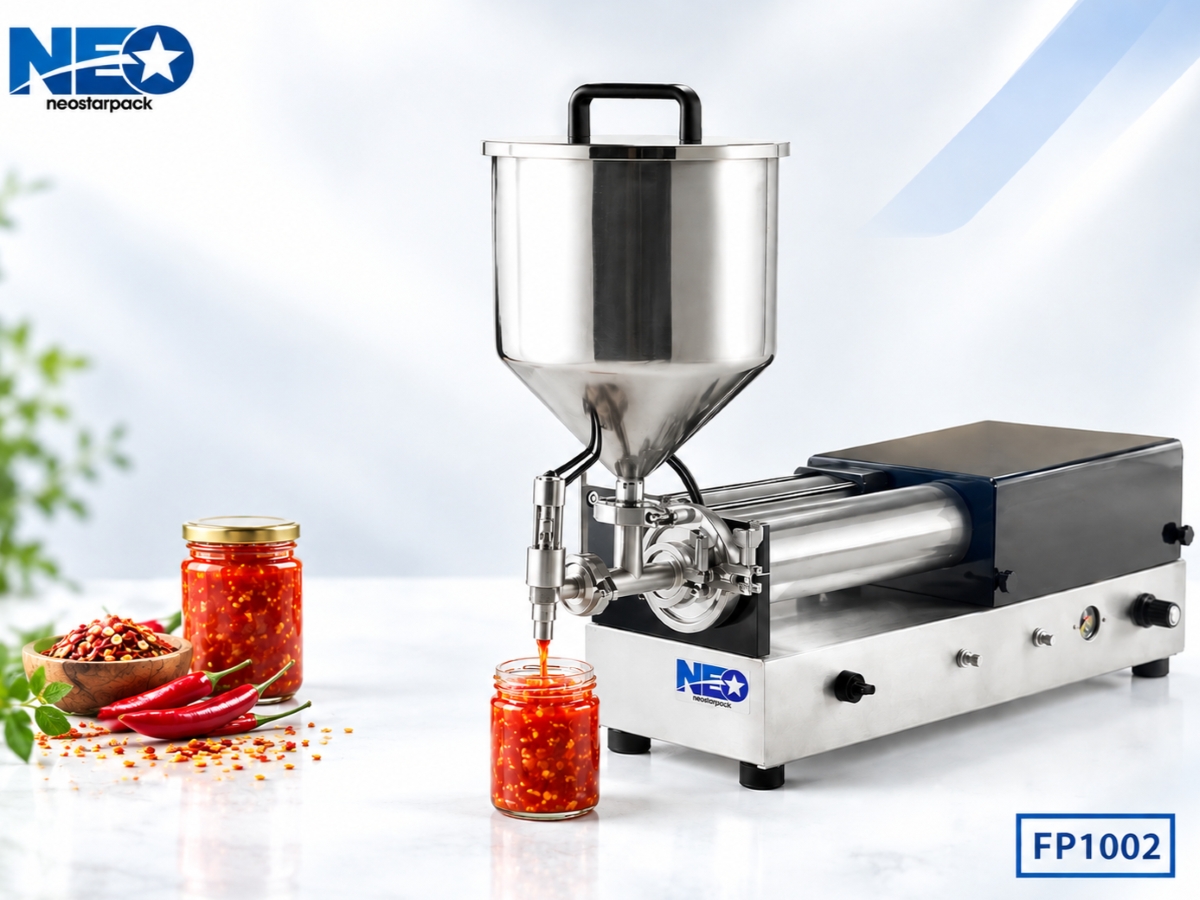
9. Can Filling Machines Handle Chili Sauce with Seeds? A Practical Guide to Selecting a Filling Machine for Seeded Sauces
Yes. However, the appropriate filling machine and filling system need to be selected based on the size of the chili seeds, seed concentration, sauce viscosity, product temperature during filling, container specifications, and filling-line configuration.
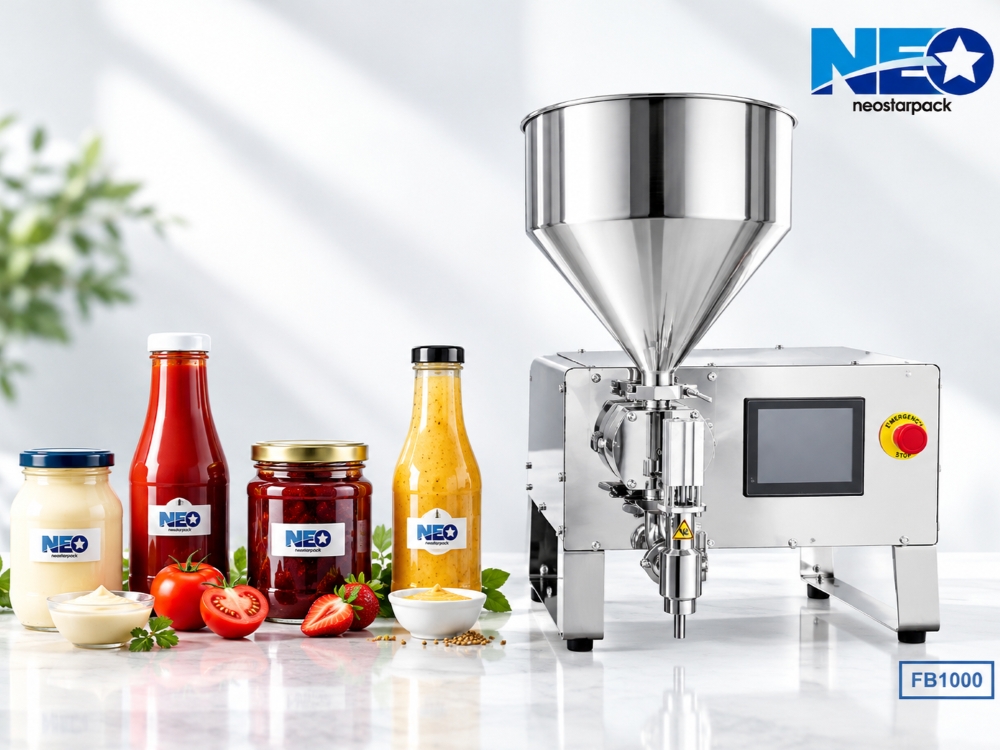
Neostarpack FP and FB series filling machines can be used for a variety of viscous sauce products, including salad dressing, chili sauce, mustard, sweet chili sauce, sweet bean paste, Japanese-style dressing, ketchup, citrus sauce, jam, and sesame sauce. Depending on production requirements, manufacturers can start with a small-capacity semi-automatic volumetric filling machine and later expand to a fully automated sauce filling line.
For products containing chili seeds, chili skin, or other particulates, filling-machine suitability cannot be evaluated based on viscosity alone. Particle size, seed concentration, sauce flow characteristics, and the entire product path from the hopper outlet to the filling head are important factors when selecting the appropriate filling machine.
If you are evaluating a filling machine for seeded chili sauce, we recommend providing product samples, containers, and expected production capacity so Neostarpack can conduct product filling tests and determine the appropriate filling machine and related components based on the test results.
1. Why Are Some Standard Liquid Filling Machines Unsuitable for Seeded Sauces?
Some standard liquid filling machines have relatively narrow product passages. When the product contains chili seeds, fruit pieces, garlic pieces, or other particulates, the following issues may occur:
• Clogging in the filling tube or valve
• Dripping or stringing during filling
• Compression or breakage of particulates
• Uneven distribution of particulate ingredients from bottle to bottle
• Unstable product flow
Whether a seeded product can be filled smoothly depends on more than the filling-head opening. The structure and dimensions of the entire product path must be considered. From the hopper outlet, valve, and hose to the pump and filling head, every component may become a restriction when particulates pass through the system.
For example, even if the filling head has a sufficiently large opening, clogging may still occur if the upstream valve or product line has a smaller internal diameter. Therefore, when selecting equipment for seeded sauces, it is important to evaluate the overall product-path dimensions, rather than looking only at the filling-head size listed in the equipment specifications.
2. What Type of Filling Machine Is Suitable for Seeded Chili Sauce?
For products containing noticeable seeds or chili skin, such as chili sauce, chili paste, garlic chili sauce, or sauces containing seeds or pieces, common filling configurations include the following.
1. Large-Bore Piston Filling Machine
A large-bore piston filling machine can be used for high-viscosity chili sauce, chili paste, garlic chili sauce, and sauces containing seeds or skin. Piston filling provides volumetric control based on the product and required fill volume. Suitability still needs to be confirmed according to the particle characteristics and product-line configuration.
2. Hygienic Rotary Lobe Pump Filling Machine — (Customized)
A hygienic rotary lobe pump filling machine may be considered for products containing a larger quantity or larger size of particulates, particularly where a gentler product-transfer process is required. The actual machine configuration and pump type should still be evaluated according to:
Product viscosity → Particle size → Particle concentration → Product temperature → Expected production capacity → Container specifications
Key Considerations When Selecting the Machine Configuration
For products containing seeds or particulates, every section of the product line needs to be matched to the product characteristics:
Hopper outlet → Valve → Hose → Pump → Filling tube
If the internal diameter of any section of the product path is too small, it may restrict the passage of particulates.
3. Why Can Chili Seeds Easily Clog Valves in Standard Filling Machines?
Clogging does not necessarily occur at the filling head. It can occur at any point upstream of the filling head. Common restriction points include:
• Small check valves
• Small-diameter product lines
• Sharp bends in the product line
• Small-diameter hoses
• Internal valve passages
As chili seeds or other particulates move through the product line, they can become obstructed at narrower sections. Therefore, for seeded chili sauce, simply increasing the filling-head opening may not resolve clogging. Whether the particulates can pass through the filling system smoothly usually depends on the minimum effective internal diameter and overall structure of the complete product path from the hopper outlet to the filling head. This is why seeded products should be evaluated based on the complete product path, rather than a single filling head or individual component.
4. Why Do Chili Seeds Settle in the Hopper? How Can This Be Prevented?
Chili seeds are typically denser than the sauce. When the sauce remains stationary in the hopper for a period of time, the seeds may gradually settle toward the bottom. Without appropriate control, this may result in differences in seed distribution during filling, for example:
Products filled earlier in the process may contain fewer chili seeds.
Products filled later may contain more chili seeds.
Common approaches include the following:
1. Low-Speed Hopper Agitator
A low-speed agitator can help keep chili seeds appropriately suspended in the sauce. The agitation speed should be adjusted according to the product characteristics. At the same time, excessive agitation should be avoided to prevent:
• Excessive particle breakage
• Excessive shear on the product
• Excessive air incorporation
Therefore, a fixed agitation speed should not simply be applied to every product. The appropriate setting should be confirmed through actual product testing.
2. Hopper Temperature Control
If sauce viscosity changes with temperature, controlling the hopper temperature can help maintain a more consistent product temperature and sauce flow characteristics. Whether temperature control is required, and what temperature range is appropriate for production, should be evaluated according to the product formulation and production conditions.
5. What Filling-Head Size Is Required for Chili Sauce Containing Particulates?
There is no single filling-head size that is suitable for every seeded chili sauce. Filling-head dimensions need to be considered together with:
• Maximum size of chili seeds or chili-skin pieces
• Seed concentration
• Sauce viscosity
• Product temperature
• Container opening size
• Valve configuration
• Internal diameter of the product
• Pump type
• Expected filling speed
Therefore, it is not recommended to determine whether a machine can handle seeded or particulate-containing sauces solely from the filling-head dimensions listed in an equipment specification sheet.
The filling-head size also needs to match the container opening to help avoid:
• Liquid splashing
• Accumulation of seeds around the container opening
• Stringing during filling
• Dripping after filling
How can this actually be confirmed?
The most reliable approach is to conduct a machine test using the actual product, including the largest seeds or pieces present in the formulation.
6. How Can You Evaluate Whether a Homemade Chili Sauce Formula Is Suitable for a Filling Machine?
When evaluating a filling machine for seeded chili sauce, testing with water alone is not recommended. Water does not have the same flow characteristics as viscous, seeded, or oil-containing sauces. A water test cannot fully represent how the actual sauce behaves in the pump, valves, product lines, and filling head.
A complete product test should evaluate the following.
1. Use Actual Product Conditions
Confirm the actual production conditions, including:
• Product formulation
• Filling temperature
• Sauce viscosity
• Particle size
• Particle concentration
2. Conduct Continuous Filling
During continuous filling, observe whether any of the following conditions occur:
• Particle settling
• Unstable product flow
• Product-line clogging
• Valve clogging
• Product accumulation at the filling head
• Dripping
• Stringing
3. Check the Filling Results
Confirm:
• Whether the fill volume meets requirements
• Whether the filling head shuts off cleanly
• Whether dripping occurs
• Whether noticeable stringing occurs
• Whether clogging occurs
7. What Should You Evaluate Before Purchasing a Filling Machine for Seeded Chili Sauce?
When selecting a filling machine, the product, container, and production conditions should be evaluated together.
| Evaluation Item | Information to Confirm | Impact on Equipment Selection |
|---|---|---|
| Product | Chili sauce, chili paste, garlic chili sauce, etc. | Determines the filling method and product-line configuration |
| Viscosity | Low, medium, or high viscosity | Affects pump and filling method |
| Particles | Seeds, chili pieces, garlic pieces, etc. | Affects valve, product-line, and filling-head configuration |
| Maximum Particle Size | Maximum seed/piece size in the product | Affects product-line dimensions |
| Particle Concentration | Particle content in each batch | Affects product transfer and agitation method |
| Temperature | Ambient-temperature or heated filling | Affects product flow characteristics and hopper configuration |
| Container | Bottle/jar, opening size, capacity | Affects filling-head and conveying configuration |
| Fill Volume | Actual filling volume per container | Affects the volumetric filling method |
| Production Capacity | Bottles/minute or bottles/hour | Affects machine model and automation level |
| Production Method | Manual, semi-automatic, or fully automatic | Affects overall equipment planning |
| Factory Space | Available equipment dimensions and production flow | Affects tabletop, standalone, or complete-line planning |
| Cleaning Requirements | Disassembly, product residue, etc. | Affects product-contact components and equipment configuration |
If you are preparing to purchase a chili sauce filling machine, we recommend providing:
① Actual chili sauce sample
② Maximum seed/piece size
③ Container and opening dimensions
④ Fill volume per container
⑤ Expected production capacity
8. How Much Does a Filling Machine for Seeded Chili Sauce Cost? How Should You Evaluate Cost and Specifications?
The purchase price is not the only factor when evaluating the cost of an automated sauce filling system. For small and medium-sized food manufacturers, it is more useful to compare:
Manual Filling Cost vs. Semi-Automatic Equipment Cost vs. Automated Production Line Cost
1. Manual Filling Cost
Hourly labor cost × Daily production hours × Monthly production days
The evaluation should also consider:
• Repetitive manual operations
• Employee training
• Production-speed limitations
• Fill-volume inspection
• Personnel replacement requirements
These factors can serve as a baseline before purchasing a filling machine.
2. Semi-Automatic Filling Equipment Cost
Semi-automatic filling equipment generally still requires production personnel for product loading, product handling, or other manual processes. However, repetitive volumetric filling operations can be performed by the machine. Therefore, the evaluation should not focus only on:
How much does the filling machine cost?
Instead, consider:
After introducing the machine, how much labor and time are still required to produce each bottle?
3. Fully Automatic Filling Line Cost
As production capacity, the number of product types, and production volume increase, it may become necessary to integrate:
Bottle feeding → Filling → Capping → Labeling → Other packaging processes
The investment cost will increase as additional equipment is integrated. At the same time, the labor requirement per unit of product may also be reduced. Whether a fully automated production system is appropriate should be evaluated together with:
Daily production volume × Production days × Labor cost × Expected service life
and the cost of the equipment and implementation.
4. Do Not Consider Only the Equipment Purchase Price
The cost of equipment for seeded sauces may also include:
• Product-contact components
• Hopper agitation system
• Temperature-control system
• Pump
• Valves
• Filling heads
• Conveying equipment
• Control system
• Installation and testing
• Production-line integration
• Cleaning and maintenance requirements
The clearer the actual production requirements, product characteristics, and equipment specifications are, the easier it is to reduce the risk of additional costs caused by clogging, unstable filling, or subsequent equipment modifications.
9. Why Should You Provide a Sample for Testing Before Purchasing a Chili Sauce Filling Machine?
For seeded chili sauce and particulate-containing sauces, sample testing is an important step before purchasing a sauce filling machine.
Product testing does more than determine whether the product can be filled. It also helps evaluate whether the machine can fill consistently, avoid clogging, and provide the required volumetric control during operation, helping identify potential production-capacity limitations before equipment purchase.
During testing, the following conditions should be observed:
• Whether particulates can pass smoothly through the filling system
• Whether clogging occurs easily
• Whether seeds are likely to break
• Whether seed distribution remains consistent during filling
• Whether fill volume remains stable
• Whether the filling head drips
• Whether stringing occurs during filling
Actual sample-test results provide a more practical basis for determining whether a machine is suitable for production than selecting a machine based only on its name or sauce viscosity.
FAQ: Common Questions About Filling Machines for Seeded Chili Sauce
Q1: Can a filling machine fill chili sauce containing seeds??
Yes. However, the appropriate filling machine needs to be selected according to seed size, seed concentration, viscosity, and product-line configuration. Actual product testing is recommended as the most practical way to confirm the suitable filling-machine configuration.
Q2: What type of filling machine is suitable for chili sauce containing seeds?
The appropriate configuration needs to be evaluated based on the product characteristics. Options may include a large-bore piston filling machine or a hygienic rotary lobe pump filling machine. The actual filling machine model still needs to be confirmed through product testing.
Q3: Why can chili seeds easily clog a filling machine?
Clogging may occur at the hopper outlet, valves, product lines, pump, filling head, or other sections of the product path. Therefore, the filling-head opening alone should not be used to determine whether clogging will occur.
Q4: Why do chili seeds settle in the filling-machine hopper?
Chili seeds are typically denser than the sauce and may gradually settle when the product remains stationary. Depending on the product characteristics, a low-speed hopper agitator may be considered. If viscosity is affected by temperature, a temperature-controlled or heated hopper may also need to be evaluated.
Q5: What filling-head size is required for seeded chili sauce?
There is no single filling-head size that is suitable for all products. The selection needs to consider maximum particle size, seed concentration, product viscosity, container opening size, and the complete product path.
Q6: Can a water test confirm whether a filling machine is suitable for chili sauce?
Not recommended. Water and viscous, seeded, or oil-containing sauces have different flow characteristics. Testing should be conducted using the actual product formulation.
Q7: Does Neostarpack provide chili sauce filling tests?
Yes. You are welcome to provide an actual sauce sample, container, fill volume, and expected production capacity. Neostarpack can conduct product testing and evaluate the equipment configuration.
Neostarpack Sauce Filling Testing Service
Neostarpack provides product testing services for manufacturers evaluating:
• Chili sauce filling machines
• Seeded chili sauce filling machines
• Salad dressing filling machines
• Garlic chili sauce filling machines
• Viscous sauce filling machines
• Jam filling machines
• Ketchup filling machines
• Filling equipment for other particulate-containing or high-viscosity liquid products
We welcome you to provide:
Product sample + Container + Fill volume + Expected production capacity
The Neostarpack team can conduct a preliminary equipment evaluation and product test based on product characteristics, container dimensions, production process, available factory space, and production-capacity requirements, and then plan the appropriate filling-machine configuration based on the test results.
Email:info@neostarpack.com
FP Series Filling Machines:
Neostarpack's FP series includes:
Small-Volume Volumetric Filling Machine FP1002, Semi-Automatic Liquid Filling Machine FP1005 , Tabletop Large-Volume Filling Machine FP1010, Energy-Saving Volumetric Liquid Filling Machine FP2000, Vertical Volumetric Filling Machine FP- 2100, 12 nozzles high-speed filling machine FP4670, double-head liquid filling machine FP4150, 6 nozzles liquid filling machine FP4300, High-Speed Automatic Filling Machine with Safety Enclosure FP5300
Photo Gallerys
-
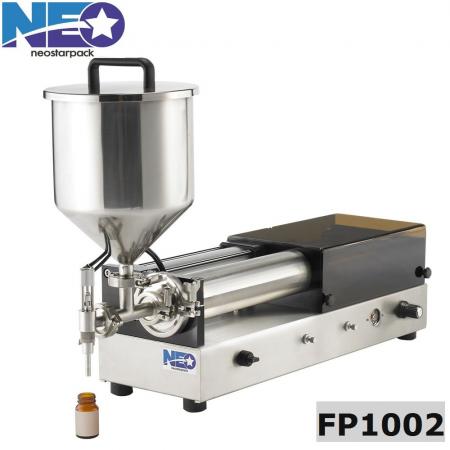 small volume quantitative filling machine
 -
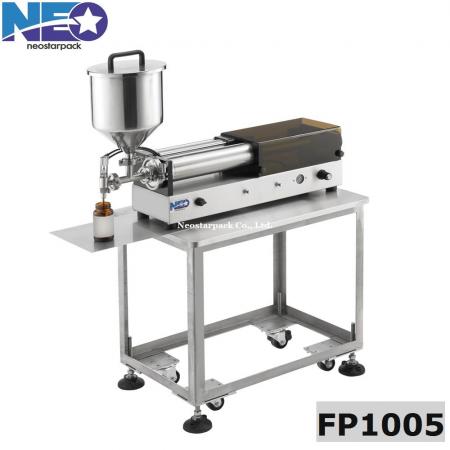 semi-automatic liquid filling machine
 -
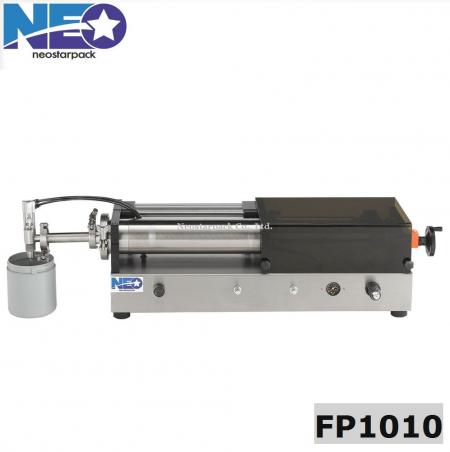 tabletop big volume filling machine
 -
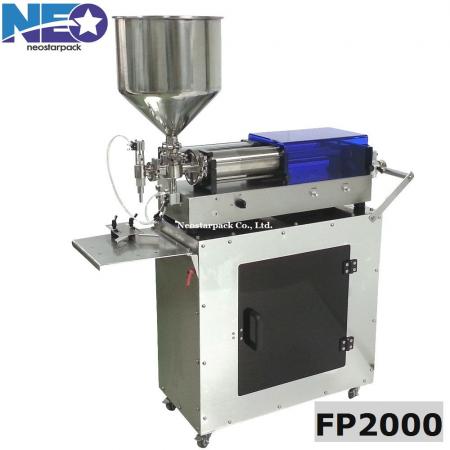 energy-saving liquid filling machine
 -
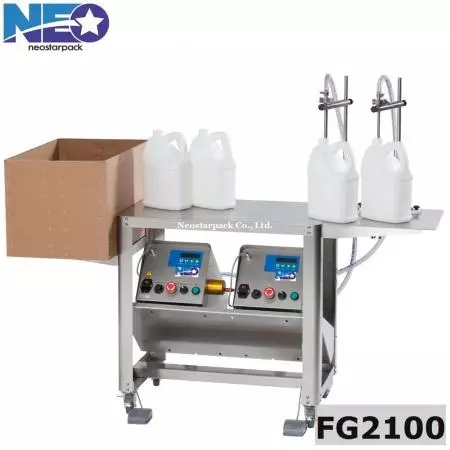 vertical filling machine
 -
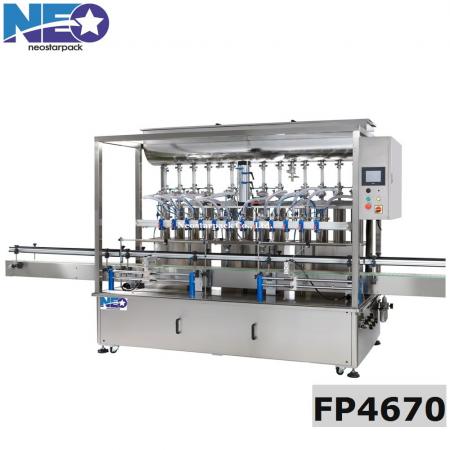 12 nozzles high-speed filling machine
 -
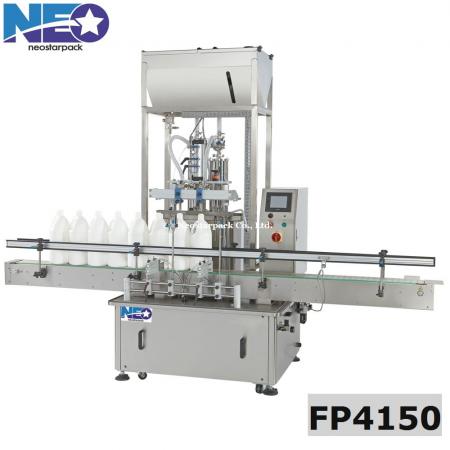 double-head liquid filling machine
 -
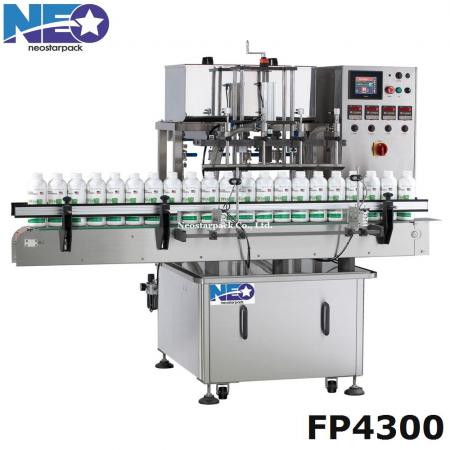 6 nozzles liquid filling machine
 -
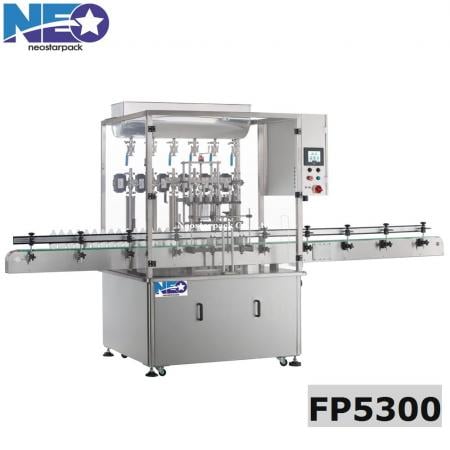 Piston liquid filler with safety cover