
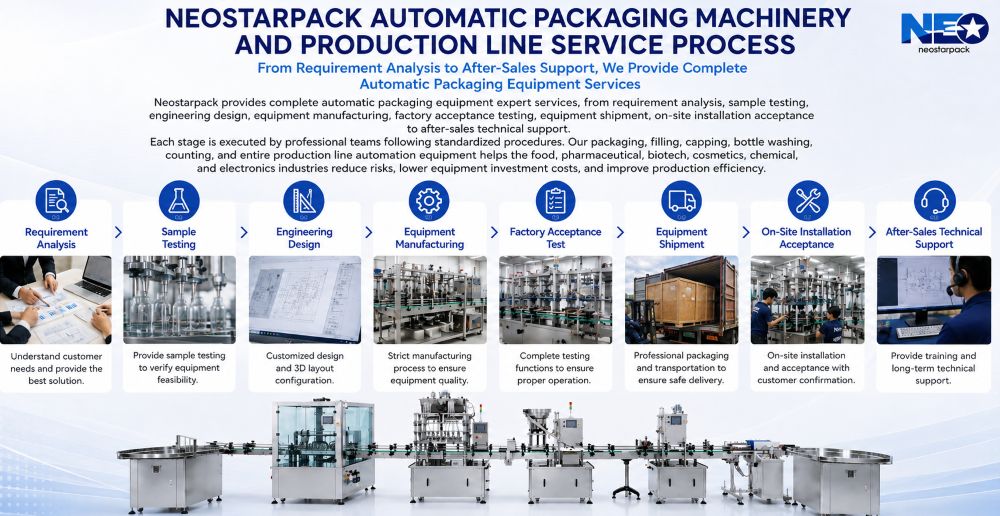
Packaging Equipment Service Process
From Requirement Analysis to After-Sales Support
Implementing automated packaging equipment is more than purchasing a machine, it is the process of building a stable, efficient, and scalable production system.
Neostarpack provides a complete project implementation process for automated packaging equipment, covering every stage from initial requirement analysis to long-term technical support. Our standardized workflow includes requirement evaluation, sample testing, engineering design, equipment manufacturing, factory acceptance testing (FAT), shipment, on-site installation, commissioning, and after-sales service.
This service process applies to:
• Labeling Machines
• Liquid Filling Machines
• Capping Machines
• Bottle Rinsing Machines
• Capsule & Tablet Counting Machines
• Bottle Unscramblers
• Complete Automated Packaging Lines
Our project management approach helps manufacturers in the food, pharmaceutical, biotechnology, cosmetics, chemical, and electronics industries reduce implementation risks while improving production efficiency.
A Structured Process for Packaging Automation Projects
From the initial discussion to after-sales technical support, Neostarpack's packaging equipment service process follows a structured project workflow:
01 — Requirement Analysis & Equipment Planning
Understand the product, production requirements, factory conditions, and equipment specifications.
02 — Product Sample Testing
Use actual customer samples to evaluate equipment compatibility and technical feasibility.
03 — Solution Proposal & Formal Quotation
Develop the equipment configuration, production line concept, customization requirements, quotation, lead time, and payment terms.
04 — Order Confirmation & Project Launch
Confirm the final specifications and formally initiate the manufacturing project.
05 — Equipment Design & Manufacturing
Complete mechanical design, component procurement, machining, assembly, electrical integration, PLC programming, and HMI configuration.
06 — Factory Testing & Parameter Adjustment
Conduct product testing, equipment verification, parameter adjustment, and factory testing before shipment.
07 — Factory Acceptance
Allow customers to verify equipment performance either at the factory or through remote video inspection.
08 — Equipment Packaging & Shipment
Complete export packaging, equipment protection, logistics coordination, and shipment.
09 — On-Site Installation & Site Acceptance
Support installation, commissioning, operator training, parameter configuration, production testing, and site acceptance.
10 — After-Sales Technical Support
Provide technical consultation, remote support, documentation, maintenance recommendations, spare parts, and warranty service.
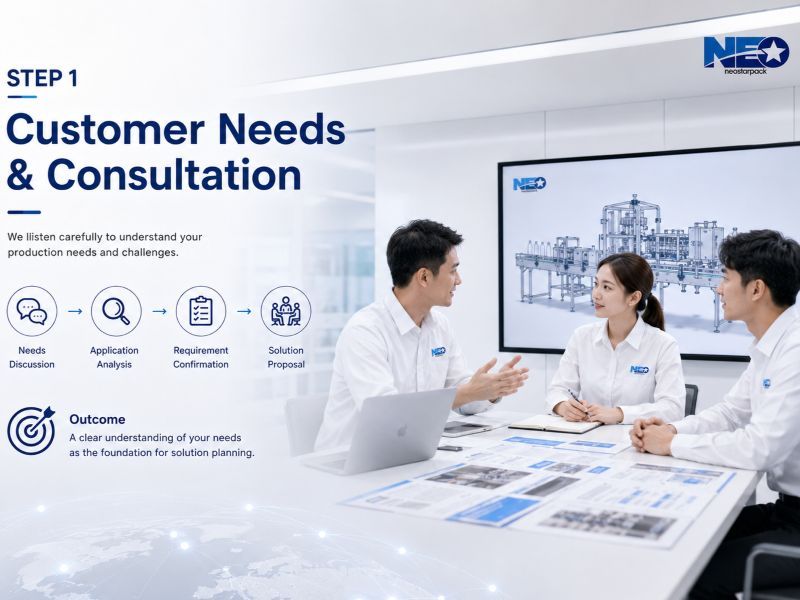
Step 1 | Requirement Analysis & Equipment Planning
Every packaging project has different product characteristics, production requirements, and factory conditions.
Before recommending equipment, our engineering team evaluates the customer's products, production objectives, available space, and technical requirements to develop an automation solution suitable for the application.
Customers are requested to provide:
• Product information
• Container specifications (bottles, jars, containers, drums)
• Container material
• Cap specifications and materials
• Label dimensions and materials
• Product characteristics
• Filling volume
• Expected production capacity
• Factory layout and available installation space
• Special customization requirements
Our engineering team performs:
• Equipment requirement confirmation
• Existing production process evaluation
• Production bottleneck analysis
• Equipment specification planning
• Preliminary production line planning
Deliverables
• Equipment or production line requirement specification
• Confirmation of customization requirements
Applicable Equipment
• Labeling Machines
• Liquid Filling Machines
• Capping Machines
• Bottle Rinsing Machines
• Capsule & Tablet Counting Machines
• Bottle Unscramblers
• Complete Packaging Lines
Customer Benefits
Clearly defining technical requirements at the beginning of the project helps reduce specification revisions, minimizes communication costs, and improves overall project efficiency.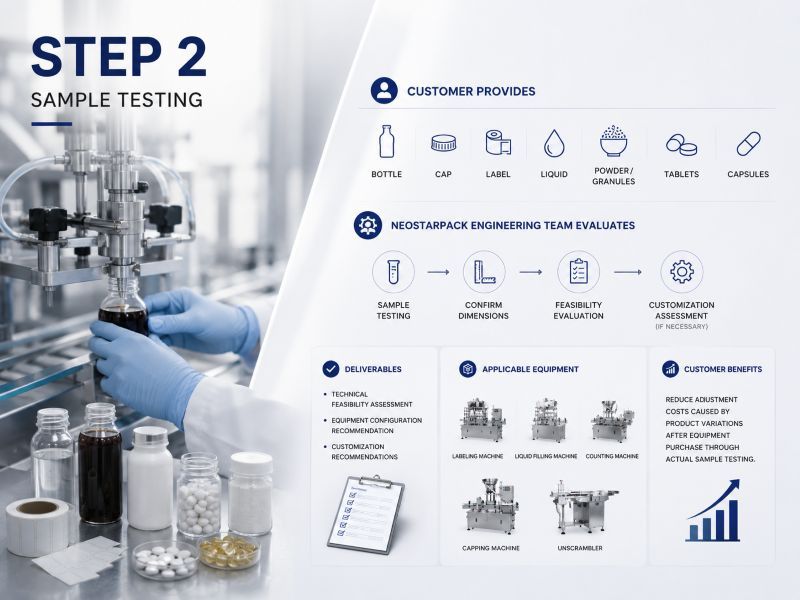
Step 2 | Product Sample Testing
Neostarpack evaluates actual customer samples—including bottles, labels, liquids, tablets, capsules, powders, and granules—to verify equipment compatibility before production begins.
Samples Provided by the Customer
Depending on the application, customers provide:
bottles, caps, labels, liquids, powders, tablets, capsules.
Engineering Evaluation
• Product sample testing
• Dimensional verification
• Filling or labeling feasibility evaluation
• Customization assessment (when necessary)
If adjustments are required, the equipment configuration is revised before manufacturing.
Deliverables
• Technical feasibility assessment
• Equipment configuration recommendations
• Customization recommendations
Customer Benefits
Testing with actual products before production helps identify potential compatibility issues early, reducing future adjustment costs after equipment installation.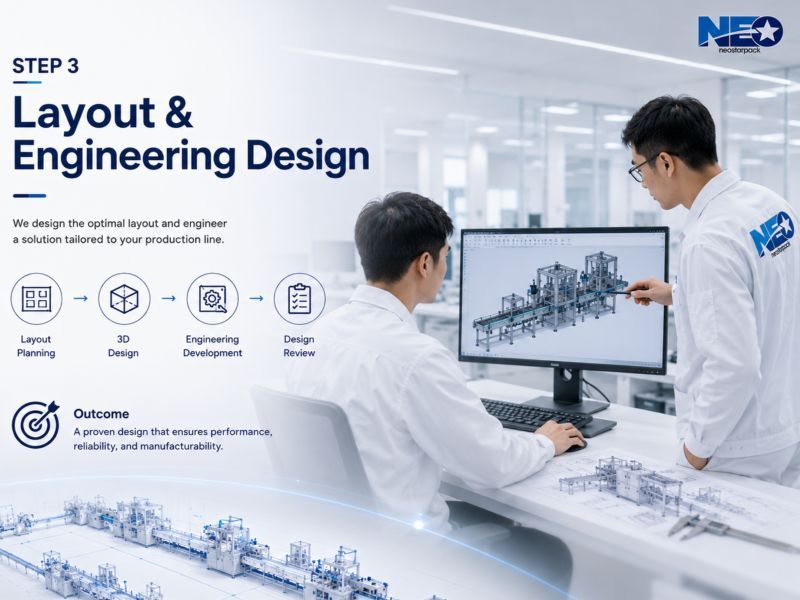
Step 3 | Solution Proposal & Formal Quotation
Based on the results of the sample evaluation and production requirement analysis, Neostarpack prepares a customized equipment proposal and formal quotation.
Proposal Includes
• Recommended equipment configuration
(such as filling machines, labeling machines, capping machines, etc.)
• Optional customized modules
• Recommended production line layout
• Preliminary machine arrangement drawing
• Formal quotation
• Estimated lead time
• Payment terms
Deliverables
• Engineering proposal
• Formal quotation
Customer Benefits
Provides the technical and commercial information required for equipment evaluation, purchasing decisions, and project budgeting.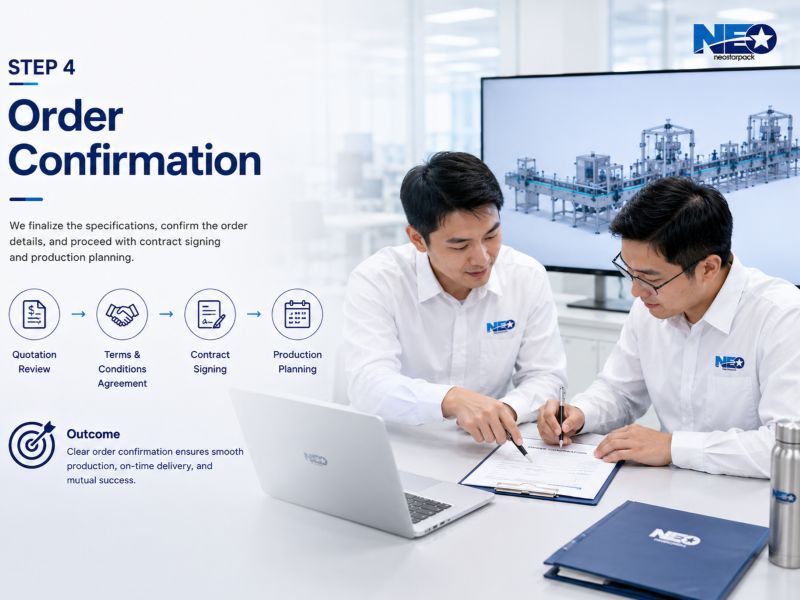
Step 4 | Order Confirmation & Project Launch
After both parties confirm the final equipment specifications, pricing, delivery schedule, and payment terms, the official order is signed.
Once the deposit is received, the manufacturing project is formally initiated.
Items Confirmed
• Equipment specifications
• Delivery schedule
• Payment terms
• Contract details
Following contract execution and deposit confirmation, the manufacturing schedule is released.
Deliverables
• Official purchase order confirmation
• ERP project creation
• Manufacturing schedule planning
Customer Benefits
Clearly defined specifications and project milestones improve project management, manufacturing coordination, and delivery planning.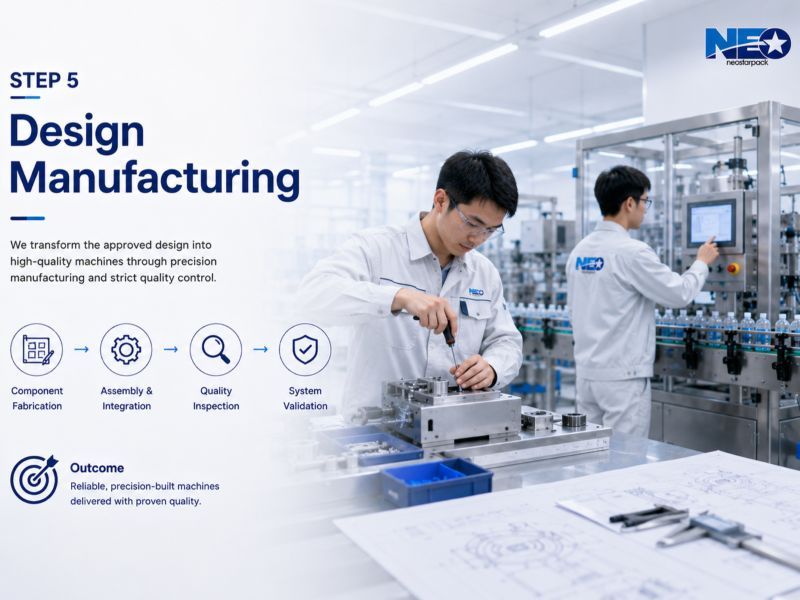
Step 5 | Equipment Design & Manufacturing
After the order is confirmed, Neostarpack begins the engineering design and manufacturing process according to the approved specifications and project requirements.
Each project follows a standardized production workflow to ensure the completed equipment meets the agreed specifications, quality standards, and production objectives.
The manufacturing process includes:
• Mechanical design
• Component and parts procurement
• Precision machining
• Mechanical assembly
• Electrical system integration
• PLC programming
• Human-Machine Interface (HMI) configuration
Throughout the project, engineering, production, purchasing, and quality control teams work together to ensure each stage progresses according to the project schedule.
Deliverables
• Complete equipment assembly
• Initial functional verification
Customer Benefits
A structured manufacturing process and project management system help ensure the equipment is built according to the approved specifications while maintaining manufacturing consistency and quality throughout the project.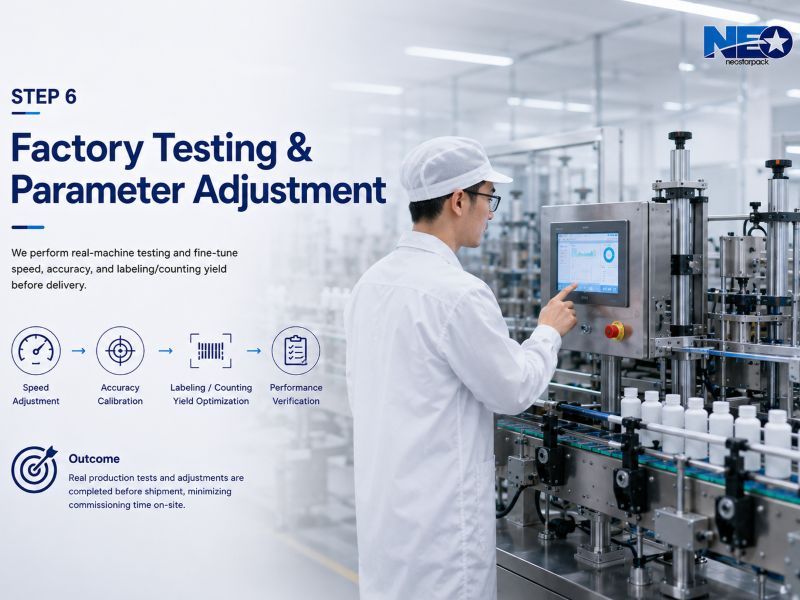
Step 6 | Factory Testing & Parameter Adjustment (Factory Acceptance Test)
Before shipment, every machine or complete packaging line undergoes comprehensive factory testing using the customer's actual products whenever available.
Equipment parameters are adjusted to verify production performance, labeling accuracy, filling consistency, counting accuracy, and overall system stability before delivery.
What the Neostarpack Team Does
Using customer-provided samples, our engineers perform:
• Labeling tests
• Filling tests
• Capping tests
• Capsule or tablet counting tests
• Continuous production operation tests
Based on the test results, machine parameters are fine-tuned to match the agreed production requirements.
Deliverables
• Equipment inspection before shipment
• Functional verification
• Parameter optimization
• Factory Acceptance Test (FAT) completion
Customer Benefits
Performing equipment verification before shipment helps minimize commissioning time after installation and allows the production line to reach stable operation more efficiently.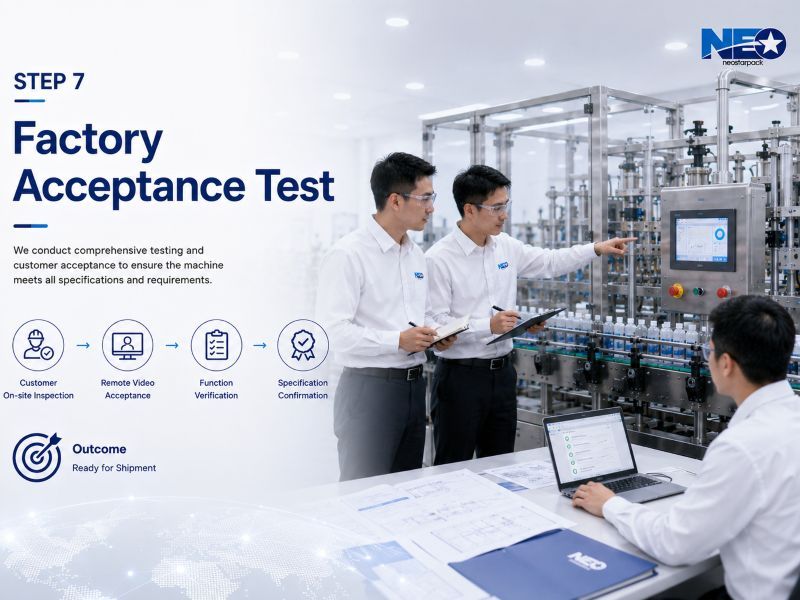
Step 7 | Factory Acceptance
After factory testing is completed and the equipment has been verified against the agreed specifications, Neostarpack arranges the Factory Acceptance process before shipment.
Customers may conduct acceptance inspections in person or remotely, depending on project requirements.
Acceptance Options
Customers may choose to:
• Visit the Neostarpack factory for on-site Factory Acceptance Testing (FAT)
• Participate through live remote video inspection for international projects
Deliverables
• Factory Acceptance completed
• Equipment approved for shipment
Customer Benefits
International customers can verify equipment performance remotely before delivery, helping reduce travel requirements while ensuring the equipment meets the agreed project specifications.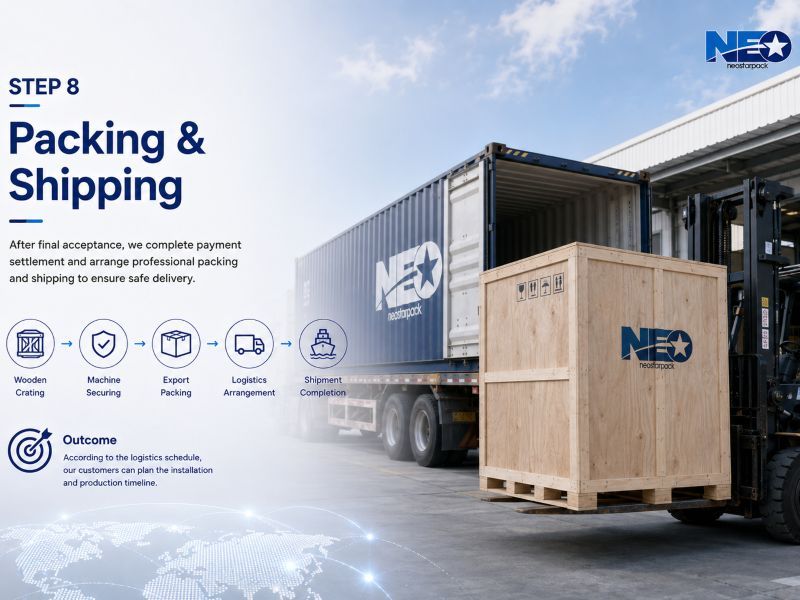
Step 8 | Equipment Packaging & Shipment
After factory acceptance has been completed and contractual payment requirements have been fulfilled, Neostarpack arranges export packaging and shipment.
Packaging methods are selected according to the equipment type, transportation method, and destination to help protect the machinery during international transportation.
Packaging & Shipping Process
The shipment process includes:
• Export wooden crate packaging
• Equipment securing and protection
• Export packaging preparation
• Logistics coordination
• Shipment release
Neostarpack works with logistics providers experienced in transporting industrial machinery to support safe international delivery.
Deliverables
• Equipment prepared for export
• Shipment completed according to the agreed logistics schedule
Customer Benefits
A standardized export packaging process helps protect equipment during transportation and allows customers to plan installation and production schedules before the machinery arrives at the factory.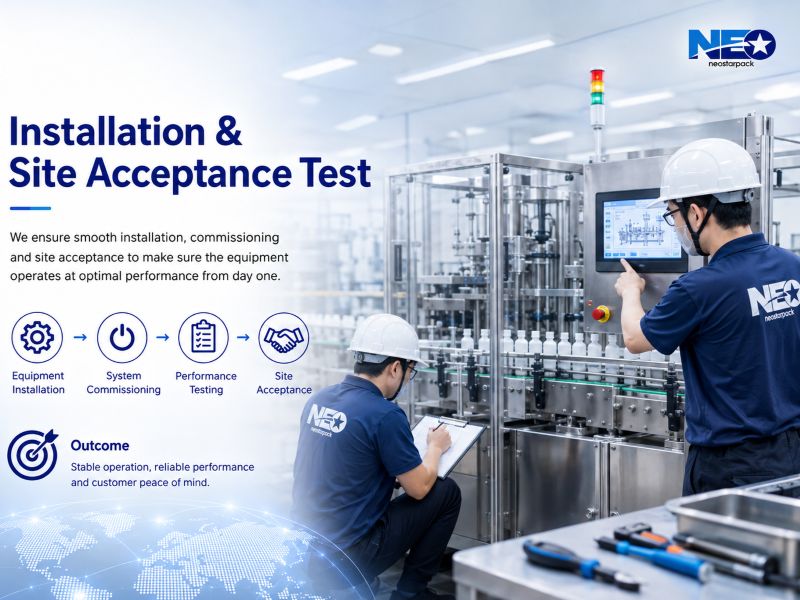
Step 9 | On-Site Installation, Commissioning & Site Acceptance
Once the equipment arrives at the customer's facility, Neostarpack provides remote or on-site technical support for equipment installation, positioning, commissioning, operator training, and site acceptance.
The objective is to help the customer complete equipment installation correctly and move the packaging equipment into formal production operation.
What Neostarpack Provides
The installation and commissioning process includes:
• Installation guidance
• Equipment positioning and setup
• Operator demonstration and training
• Machine parameter adjustment and configuration
• Production testing
• Site Acceptance Test (SAT)
• Installation completion
Depending on the project requirements and customer location, technical support can be provided remotely or through on-site engineering assistance.
On-Site Process
Installation Guidance → Operator Training → Parameter Configuration → Production Testing → Site Acceptance → Installation Completion
During commissioning, the equipment is adjusted according to the actual production environment, product specifications, container dimensions, and agreed operating requirements.
Deliverables
• Equipment installation completed
• Machine parameters configured
• Operator training completed
• Site testing and acceptance completed
Customer Benefits
A structured installation and commissioning process helps shorten equipment implementation time and supports a smoother transition from equipment installation to formal production.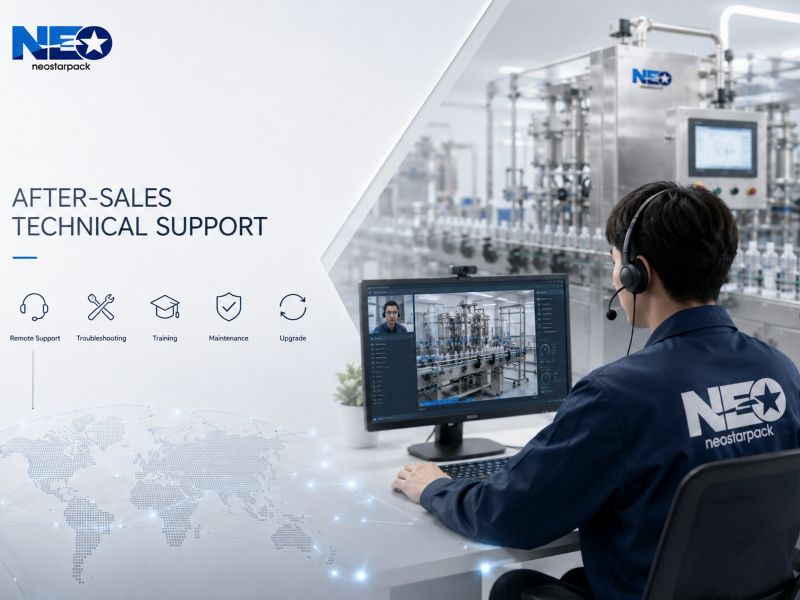
Step 10 | After-Sales Technical Support
After the equipment enters production, Neostarpack continues to provide technical support to help customers maintain stable equipment operation over the long term.
In addition to standard operating documentation, Neostarpack provides maintenance and servicing recommendations based on the equipment and application.
Technical Support Services
• Technical consultation
• Remote online technical support
• Equipment operating documentation
• Maintenance and servicing recommendations
• Spare parts supply
• Warranty service
Technical support may be provided remotely or through other applicable service channels depending on the customer's requirements and equipment situation.
Customer Benefits
Ongoing technical support and maintenance recommendations help customers maintain stable equipment operation, address technical issues more efficiently, and support the long-term service life of the packaging equipment.
Why the Service Process Matters
Automated packaging equipment is closely connected to the product, container, packaging materials, production capacity, factory layout, and downstream equipment.
For this reason, equipment implementation should not be considered only as the purchase of an individual machine. A complete project requires coordination between product requirements, equipment configuration, production processes, factory conditions, testing, installation, and ongoing technical support.
Neostarpack's service process provides a structured framework covering these stages, from the initial equipment evaluation through production implementation and after-sales support.
This approach can be applied to individual packaging machines as well as integrated automated production lines.
Applicable Packaging Equipment
The service process can be applied to a wide range of packaging automation projects, including:
• Labeling Machines
For round bottles, flat containers, front-and-back labeling, wrap-around labeling, and other labeling applications.
• Liquid Filling Machines
For different liquid characteristics, filling volumes, container sizes, and production requirements.
• Capping Machines
For automated cap feeding, cap placement, screw capping, and other container closing applications.
• Bottle Rinsing Machines
For cleaning and preparing containers before filling.
• Capsule & Tablet Counting Machines
For counting and bottling capsules, tablets, and other solid products.
• Bottle Unscramblers
For automatic bottle handling and container preparation before downstream packaging processes.
• Complete Automated Packaging Lines
Integration of multiple processes such as bottle rinsing, filling, capping, labeling, conveying, and other packaging operations.
Industries We Serve
Neostarpack's packaging equipment service process can support automation projects across multiple manufacturing industries, including:
• Food & Beverage
• Pharmaceuticals
• Biotechnology
• Nutraceuticals
• Cosmetics & Personal Care
• Chemicals
• Electronics
The appropriate equipment configuration is determined according to the customer's product characteristics, production requirements, packaging format, and factory conditions.
- Q&A
Q1. How early should equipment requirements be discussed?
A: Equipment requirements should be evaluated before the project begins. Product characteristics, container dimensions and materials, label specifications, filling volume, expected production capacity, available factory space, and customization requirements can affect equipment selection and system design.Q2. Why does Neostarpack conduct sample testing before manufacturing?
A: Actual product and packaging samples allow the engineering team to evaluate equipment compatibility and identify potential technical requirements before manufacturing. This can reduce the need for modifications after equipment installation.Q3. Can international customers conduct Factory Acceptance Testing remotely?
A: Yes. International customers can choose to participate in factory testing through remote video inspection, allowing them to observe actual equipment operation and confirm the agreed specifications before shipment.Q4. Does Neostarpack provide on-site installation?
A: Depending on the project requirements and location, Neostarpack provides remote installation guidance or on-site technical support for equipment installation, commissioning, operator training, and site acceptance.Q5. Can Neostarpack integrate several packaging machines into one production line?
A: Yes. Neostarpack can plan and integrate packaging processes involving equipment such as bottle rinsers, filling machines, capping machines, labeling machines, conveyors, and other packaging equipment according to the customer's production requirements.Q6. What happens after the equipment is installed?
A: After installation and site acceptance, Neostarpack continues to provide technical consultation, remote support, operating documentation, maintenance recommendations, spare parts supply, and warranty service.