
Soy Sauce Filling Automation Success Story | Japanese Century-Old Soy Sauce Manufacturer Upgrades to a Customized Automated Filling Packaging Line, Increasing Productivity While Reducing Labor Requirements by 75%
Project Overview
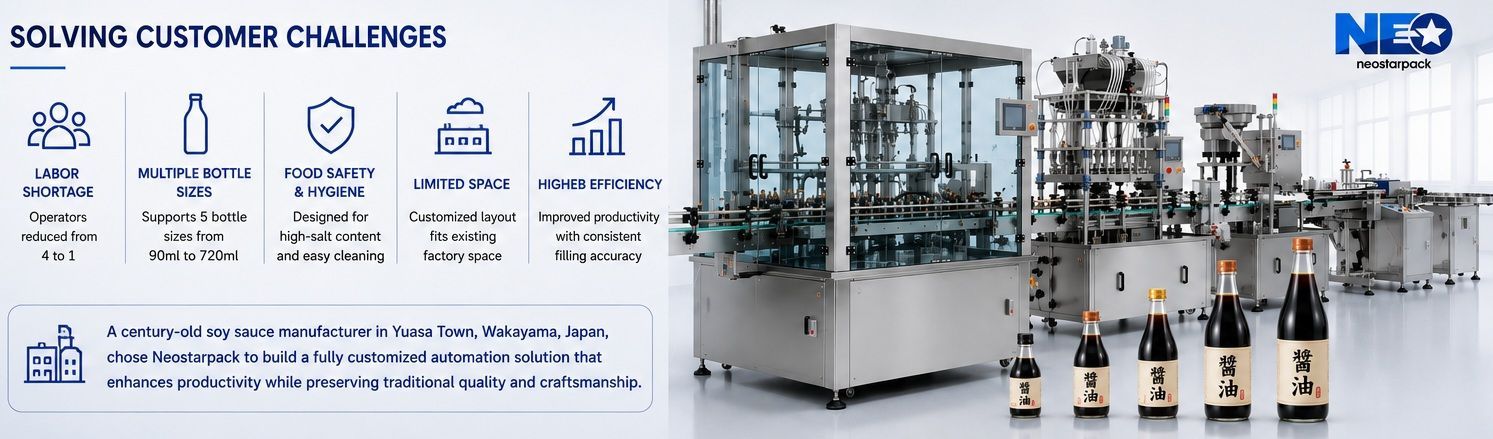
A century-old soy sauce manufacturer located in Yuasa, Wakayama, Japan, sought to modernize its production by introducing an automated soy sauce filling and capping line. The project was driven by Japan's growing labor shortage, an aging workforce, and the need to maintain food safety standards while supporting multiple bottle formats within limited factory space.
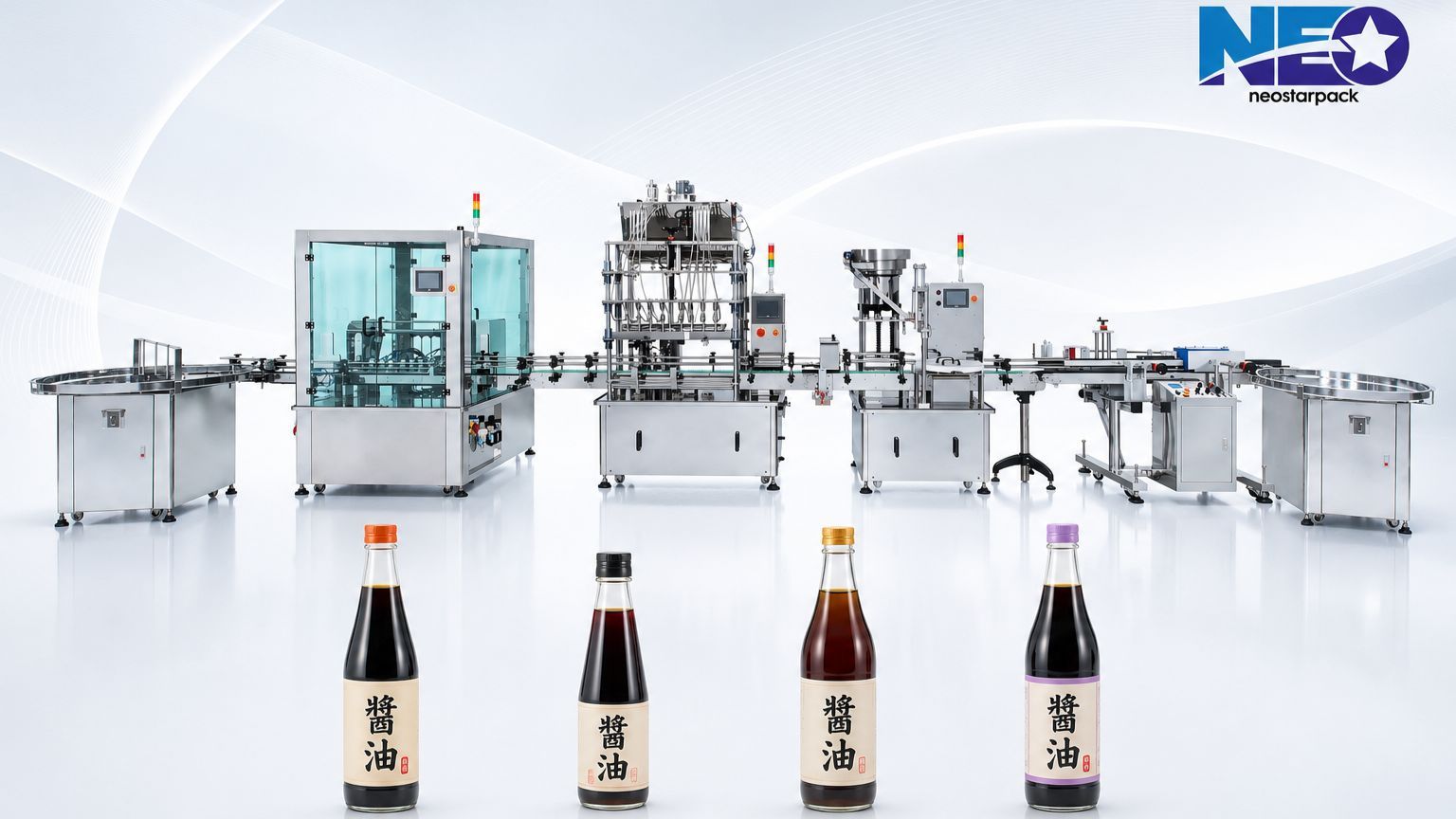
Neostarpack designed and supplied a customized bottling solution integrating bottle rinsing, liquid filling, automatic capping, labeling, and conveyor automation. The production line was engineered specifically around the customer's product characteristics, existing factory layout, and long-term production requirements.
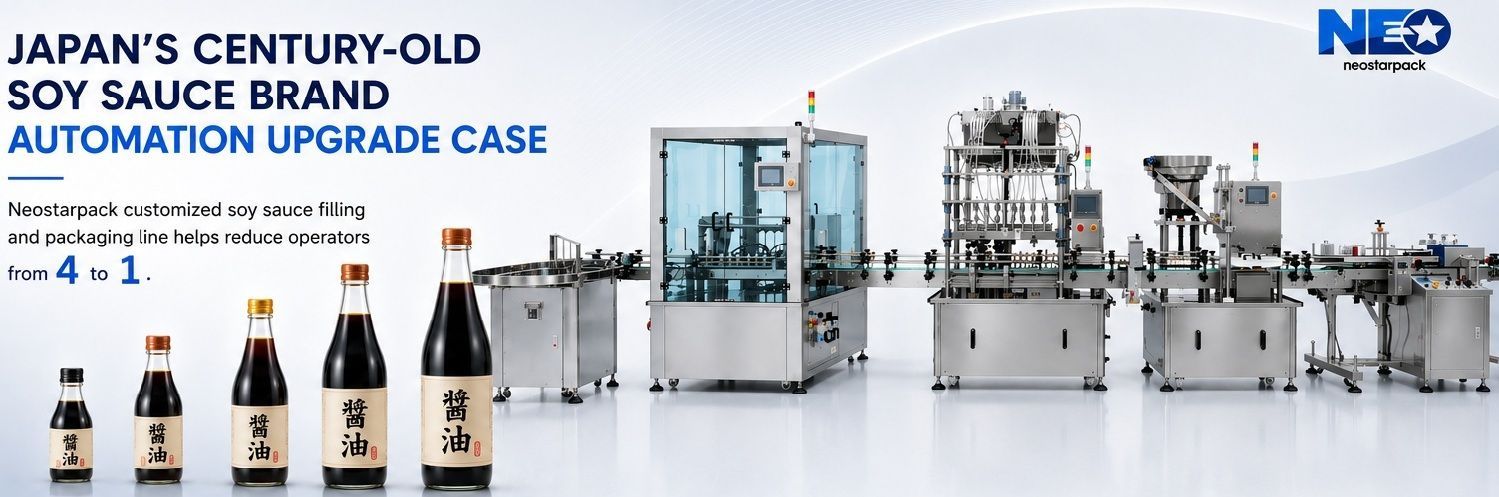
Following implementation, the customer successfully reduced production staffing from four operators to one, while enabling a single production line to handle five glass bottle sizes ranging from 90 ml to 720 ml. The new system improved production efficiency without compromising the traditional manufacturing standards that define the brand.
Project Snapshot
Item | Details |
Industry | Traditional Soy Sauce Manufacturing |
Location | Yuasa, Wakayama, Japan |
Product | Naturally Brewed Soy Sauce |
Packaging Format | Glass Bottles |
Bottle Sizes | 90 ml, 150 ml, 200 ml, 500 ml, 720 ml |
Production Challenge | Labor shortage, multiple bottle formats, limited factory space, food-grade production requirements |
Solution | Customized automated soy sauce bottling and capping line |
Integrated Equipment | Bottle rinsing, liquid filling, capping, labeling, conveyor system |
Primary Results | Labor reduced from 4 operators to 1 while improving production efficiency and operational flexibility |
About the Customer
The customer is one of the two best-known century-old soy sauce manufacturers located in Yuasa, Wakayama Prefecture, Japan. Yuasa is widely recognized as one of the birthplaces of traditional Japanese soy sauce production and remains well known for preserving its historic wooden-barrel fermentation techniques.
Committed to preserving traditional craftsmanship, the company continues to produce soy sauce using domestically sourced Japanese ingredients and natural brewing methods. While maintaining its long-established product quality and brand heritage, the manufacturer also recognized the need to modernize production in response to changing labor conditions and evolving market demand.
Rather than replacing traditional manufacturing practices, the customer's objective was to introduce automation that would improve operational efficiency while preserving the production standards that distinguish its products.
Manufacturing Challenges
Although the company's product quality remained highly regarded, its production operation faced several practical manufacturing challenges common across Japan's food industry.
The most significant issue was the increasing shortage of skilled production workers. As experienced employees approached retirement, recruiting younger operators became progressively more difficult. Manual filling and capping processes that had been reliable for decades gradually became constraints on productivity, staffing flexibility, and future production capacity.
The manufacturer also produced multiple product sizes, requiring frequent production changeovers. More than five different glass bottle formats ranging from 90 ml to 720 ml were in regular production. Under the existing manual process, each product change required considerable operator time and increased production scheduling complexity.
Food safety requirements added another layer of engineering considerations. Soy sauce is a high-salinity liquid, and certain formulations also contain sugar. Equipment therefore needed to provide excellent corrosion resistance while remaining easy to clean in order to maintain hygienic production conditions and long-term operational reliability.
At the same time, the available factory space limited the installation of conventional large-scale production equipment. Any new system would need to integrate efficiently within the existing production environment without disrupting plant workflow.
The customer therefore required an automation filling and capping solution capable of improving production efficiency, reducing labor dependency, supporting multiple bottle formats, and meeting food-grade manufacturing requirements within the constraints of the existing facility.
Project Requirements
Following multiple technical discussions with the Neostarpack engineering team, the customer defined several key objectives for the new production line.
1. Support Multiple Bottle Sizes
The production line needed to accommodate five different glass bottle sizes—90 ml, 150 ml, 200 ml, 500 ml, and 720 ml—while minimizing downtime during product changeovers.
2. Handle High-Salinity Soy Sauce
All components in direct contact with the product were required to provide excellent corrosion resistance suitable for continuous production of high-salinity liquids while complying with food-grade manufacturing requirements.
3. Simplify Cleaning and Maintenance
Because certain soy sauce formulations contain sugar, the equipment needed to be designed for efficient daily cleaning to reduce product residue, maintain hygienic conditions, and support stable long-term operation.
4. Integrate Within the Existing Factory Layout
The customer required a production line designed around the available factory space, allowing efficient workflow while preserving future expansion flexibility.
5. Reduce Labor Dependency
The primary automation objective was to reduce reliance on manual labor, improve production efficiency, and maintain consistent product quality despite ongoing workforce shortages.
Why Neostarpack
Before selecting Neostarpack, the customer evaluated several filling packaging equipment suppliers in Japan. While many offered standardized filling systems, the customer required a solution specifically engineered around its products, manufacturing process, and factory layout rather than an off-the-shelf machine.
The introduction to Neostarpack came through the customer's Taiwanese soy sauce distributor. After observing Neostarpack's equipment in operation at an exhibition in Japan, the customer began a detailed evaluation of the company's engineering capabilities, project experience, and long-term service support.
As is common among Japanese manufacturers, supplier selection was based on long-term reliability rather than immediate purchasing decisions. Over approximately one year, the customer reviewed Neostarpack's automation filling projects across multiple industries before selecting the company to design and integrate its complete soy sauce filling and capping packaging line.
Key Factors Behind the Decision
• Customized engineering tailored to the customer's products, production process, and factory layout.
• Proven capability in integrating bottle rinsing, liquid filling, capping, labeling, and conveyor systems into a complete automated production line.
• Flexible production line design supporting rapid changeover between multiple bottle sizes.
• Extensive experience in food filling equipment and liquid capping packaging applications.
• Comprehensive project planning, engineering consultation, installation, and technical support.
• Equipment designed for long-term operational stability and continuous food manufacturing environments.
Customized Soy Sauce Filling Solution
Rather than supplying a standard filling machine, Neostarpack engineered a customized automated soy sauce bottling line based on the customer's product characteristics, manufacturing process, factory layout, and long-term production objectives.
The project addressed several key operational requirements simultaneously, including support for multiple bottle sizes, food-grade production standards, simplified cleaning procedures, limited factory space, and reduced labor dependency.
The complete solution integrates botte rinsing, liquid filling, capping, labeling, conveyor transport, and centralized PLC control into a coordinated production system. Each workstation communicates through an integrated control architecture to ensure stable line operation while maintaining production flexibility for future expansion.
Beyond increasing production capacity, the primary engineering objective was to help the customer preserve the quality associated with its century-old soy sauce manufacturing process while gradually transitioning to automated production.
Solution Architecture
The customized filling production line consists of six integrated production modules.
Bottle Infeed → Bottle Rinser → Liquid Filling Machine → Automatic Capping → Round Bottle Labeling Machine → Conveyor & Product Outfeed
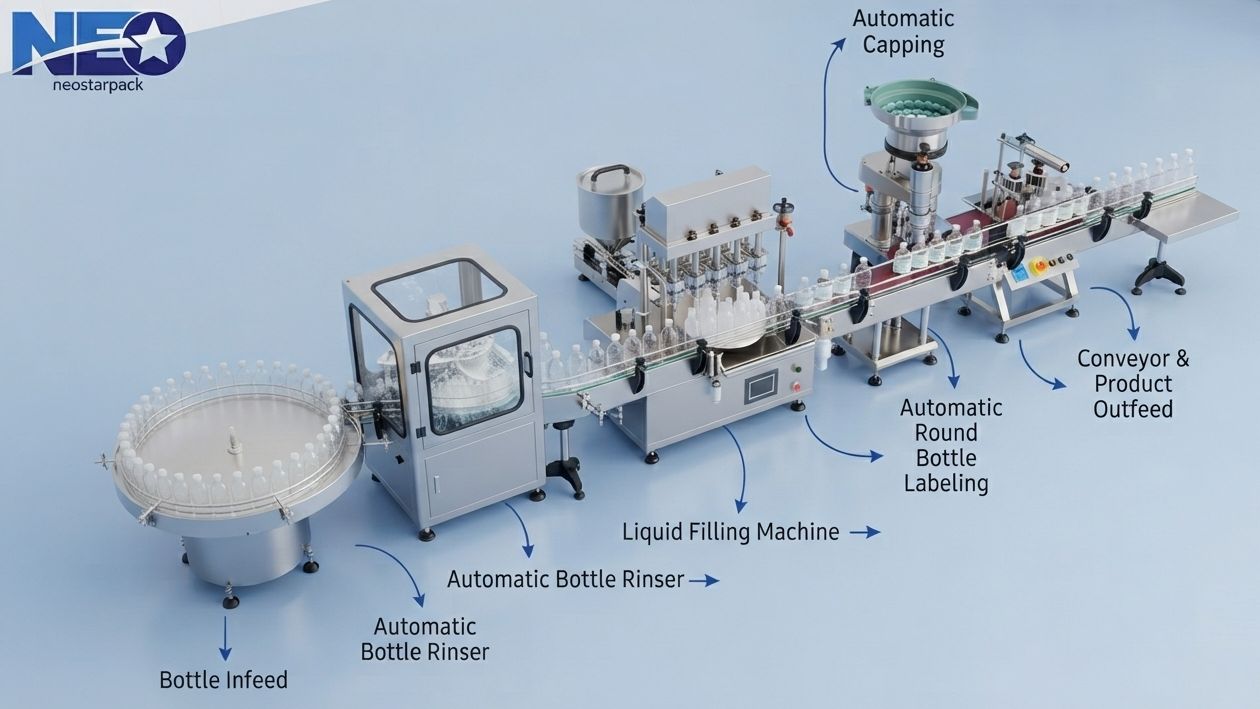
Each production station is synchronized through the PLC control system, allowing the entire packaging line to operate as one coordinated process rather than as independent machines. This solution architecture improves operational consistency, reduces manual intervention, and simplifies future equipment upgrades when production requirements evolve.
Production Equipment
| Equipment | Function |
|---|---|
| Bottle Rinser | Removes dust and foreign particles from bottles before filling to improve container cleanliness. |
| Liquid Filling Machine | Designed specifically for soy sauce production and supports multiple glass bottle capacities. |
| Capping Machine | Automatically places and tightens bottle caps to ensure consistent sealing quality. |
| Labeling Machine | Applies labels accurately across different bottle sizes while maintaining product presentation consistency. |
| Customized Conveyor System | Connects each workstation to create a continuous production flow throughout the packaging line. |
| PLC Control System | Coordinates all equipment, synchronizes production processes, and improves overall operational stability. |
Design Philosophy
For this project, automation was not treated as the objective itself.
Instead, every engineering decision was evaluated according to four practical manufacturing priorities:
• Maintaining traditional soy sauce production quality.
• Improving operational efficiency.
• Reducing dependence on manual labor.
• Supporting sustainable long-term production.
The resulting filling capping production line combines customized mechanical engineering, integrated automation, and practical operational design to help the customer modernize production while preserving the manufacturing standards associated with its century-old brand.
Technical Advantages of the Customized Filling & Capping Production Line
Compared with conventional standardized filling systems, this customized solution provides several operational advantages tailored to the customer's manufacturing requirements.
| Engineering Requirement | Neostarpack Solution |
|---|---|
| Multiple bottle sizes | Supports five glass bottle formats on a single production line. |
| High-salinity soy sauce | SUS316 wetted parts provide enhanced corrosion resistance. |
| Product cleanliness | Hygienic equipment design simplifies routine cleaning and maintenance. |
| Limited factory space | Production line customized to fit the existing plant layout. |
| Labor shortage | Automated bottle rinsing, filling, capping, and labeling reduce manual operations. |
| Future expansion | Modular architecture supports future production upgrades and equipment integration. |
Implementation Results
Following on-site installation, commissioning, and production validation in Wakayama, Japan, the customized automated soy sauce bottling filling and capping line was successfully integrated into the customer's existing manufacturing facility.
The completed system established a food-grade automated filling production line that combines bottle rinsing, liquid filling, capping, labeling, and conveyor handling within a unified workflow. Rather than replacing the customer's traditional brewing process, the automation solution was designed to improve packaging efficiency while preserving the production quality associated with the brand's long-established manufacturing methods.
One of the most significant operational improvements was the reduction in labor requirements. Previously, four operators were required to complete the packaging process. After commissioning the new production line, routine operation could be managed by a single operator, substantially reducing labor dependency while improving production consistency.
The customized line also enables multiple bottle sizes to be produced on the same system, reducing downtime associated with product changeovers and improving scheduling flexibility for smaller production batches.
Production Performance Comparison
| Production Item | Before Implementation | After Implementation |
|---|---|---|
| Operators Required | 4 | 1 |
| Production Method | Manual Packaging Process | Fully Integrated Automated Bottling Line |
| Production Capacity | Manual Operation | Approximately 600 bottles per hour |
| Bottle Size Flexibility | Manual Changeover | One production line supports multiple bottle sizes |
| Filling Consistency | Operator-dependent | Stable and consistent production quality |
Outcomes
The customized filling production line helped the customer achieve several measurable operational improvements.
1. Reduced Labor Requirements
Automation reduced the number of production operators from four to one, helping address workforce shortages while lowering dependence on manual labor.
2. Improved Production Efficiency
By integrating bottle rinsing, filling, capping, labeling, and conveying into one coordinated production line, the customer achieved a more efficient and continuous packaging process.
3. Production Flexibility
A single production line now supports multiple glass bottle formats ranging from 90 ml to 720 ml, enabling more flexible production scheduling without requiring separate filling systems.
4. More Consistent Packaging Quality
Automated filling and packaging reduce variations associated with manual operation, helping improve filling consistency and overall product presentation.
5. Food-Grade Equipment
All product-contact components are manufactured using food-grade materials suitable for soy sauce production, improving corrosion resistance, hygiene, and long-term equipment durability.
6. Customized Production Line Integration
Rather than installing individual standalone machines, the project delivered a complete automated filling packaging solution designed around the customer's products, factory layout, and production workflow.
Engineering Considerations for Soy Sauce Filling Automation
Soy sauce presents several engineering characteristics that should be considered when designing an automated filling line. As a high-salinity liquid, the product requires corrosion-resistant wetted materials. Certain formulations also contain sugar, making equipment cleanliness and routine maintenance important factors in maintaining hygienic production.
Depending on the formulation, soy sauce may also generate foam during filling. Production line planning therefore typically considers anti-foaming filling methods, filling parameter optimization, and equipment configurations that support stable filling across different bottle sizes.
When manufacturers produce multiple container formats on a single line, recipe management and simplified product changeover become equally important. Production systems designed with parameter-based changeover and minimal mechanical adjustment can improve operational flexibility while reducing setup time between products.
Customer Testimonial
"Neostarpack provided more than automation filling equipment. Their engineering team took the time to understand our products, manufacturing process, bottle specifications, and production requirements before proposing a customized solution. The soy sauce filling production line was designed around the characteristics of soy sauce and our existing factory environment, allowing us to modernize our packaging process while maintaining the product quality our customers expect."
— Soy Sauce Manufacturer, Japan
Industry Applications
Although this project was developed for traditional soy sauce production, the engineering principles apply to many liquid food manufacturers with similar production characteristics. This customized bottling filling solution is suitable for manufacturers requiring flexible production, multiple bottle formats, food-grade materials, and efficient automated packaging.
Typical applications include:
1. High-Salinity and Acidic Liquid Foods
Soy sauce, Seasoning sauces, Black vinegar, Rice vinegar, Fruit vinegar, Fish sauce, Barbecue sauce, Mirin, Liquid seasonings
2. High-Viscosity or Sugar-Containing Liquids
Honey, Concentrated syrup, Fruit jam, Thick soy sauce, Other viscous food products requiring simplified cleaning
3. Premium Bottled Food Products
Olive oil, Flaxseed oil, Sesame oil, Cooking sake, Craft alcoholic beverages, Fermented health beverages
4. Manufacturers with Similar Production Requirements
This filling solution is also suitable for manufacturers that:
• Produce multiple bottle sizes.
• Operate within limited factory space.
• Face labor shortages or an aging workforce.
• Require food-grade hygienic equipment.
• Need greater production flexibility.
• Plan to gradually automate existing manual packaging operations.
Applicable Industries
This customized solution can be adapted for a wide range of food manufacturing sectors, including:
• Food Processing
• Seasoning and Condiment Manufacturing
• Fermented Food Production
• Edible Oil Manufacturing
• Beverage Production
• Liquid Nutraceutical Manufacturing
• OEM / ODM Food Manufacturing
• Small and Medium-Sized Food Factories
• Multi-SKU Food Production Facilities
Who Is This Solution Designed For?
This automated soy sauce bottling filling capping line is particularly suitable for manufacturers that need to:
• Reduce labor requirements while maintaining production quality.
• Produce multiple bottle sizes on a single production line.
• Improve production efficiency and packaging consistency.
• Process high-salinity or sugar-containing liquid foods.
• Install equipment within limited factory space.
• Upgrade from manual packaging to automated production without compromising product quality.
Industry Perspective
Across the global food manufacturing industry, labor shortages, increasing product variety, and stricter food safety requirements continue to drive investment in packaging automation.
Successful automation packaging projects involve more than selecting individual machines. Production line planning should consider product characteristics, bottle specifications, production volume, cleaning requirements, available factory space, and long-term operational objectives.
By combining customized engineering with integrated automation, manufacturers can improve production efficiency while preserving product quality and maintaining the flexibility needed for future business growth.
About Neostarpack
Neostarpack Co., Ltd. is a Taiwan based manufacturer specializing in automated bottling filling packaging machinery and customized filling production line integration. With more than 20 years of engineering experience, we design and manufacture labeling machines, liquid filling machines, bottle rinsers, capping machines, labeling machines, tablet capsule counting machines, and complete bottling lines for the food, pharmaceutical, nutraceutical, cosmetics, chemical, and manufacturing industries.
Our focus is not simply supplying machinery, but helping manufacturers build production systems that improve efficiency, maintain product quality, simplify operation, and support sustainable long-term growth.
Contact Neostarpack
Planning an Automated Filling and Packaging Line for Your Food Products?
Every liquid food product has unique formulation characteristics, packaging specifications, production capacities, and operational requirements. Selecting an automated filling system involves more than choosing a standard machine—it requires evaluating the product, manufacturing process, factory layout, and long-term production objectives.
Whether you manufacture soy sauce, seasoning sauces, edible oils, vinegar, fermented liquids, or other liquid food products, Neostarpack can provide engineering consultation and customized production line planning based on your specific application.
Our engineering team works closely with manufacturers to recommend equipment configurations that align with product characteristics, packaging formats, production targets, and available factory space.
Contact us to discuss your automated bottling filling and capping packaging project.
Email: info@neostarpack.com
- Feature
1. Multi-Bottle Production Flexibility
One of the project's primary design objectives was to support multiple product formats using a single production line. The completed system accommodates five standard glass bottle sizes: 90 ml, 150 ml, 200 ml, 500 ml, 720 ml.
Rather than requiring separate production equipment for different products, the customized adjustment mechanisms and PLC recipe management enable operators to switch between bottle formats with minimal production interruption.
2. Food-Grade Design for High-Salinity Liquids
Soy sauce presents unique engineering challenges because of its high salt concentration and, in some formulations, sugar content. To improve long-term equipment durability and maintain hygienic production conditions, all wetted components that come into direct contact with the product are manufactured from SUS316 stainless steel.
This material selection provides excellent corrosion resistance for continuous processing of high-salinity liquids while meeting the material requirements commonly specified for food manufacturing equipment.
3. Hygienic Equipment Design
Soy sauce formulations containing sugar can leave product residue inside filling paths if equipment is not cleaned effectively after production.
The filling production line was therefore designed to simplify routine cleaning and maintenance, helping operators reduce cleaning time, minimize product residue, and maintain hygienic operating conditions between production batches.
4. Filling Production Line Integration
Instead of operating each machine independently, every workstation is integrated through a centralized PLC control system. The system synchronizes:
Bottle rinsing → Filling → Cap feeding → Automatic capping → Labeling → Conveyor transport
Centralized control allows operators to manage production parameters from a single interface while maintaining stable communication between each station throughout the production process.
5. Factory Space Optimization
Many traditional food manufacturers operate within existing facilities where additional floor space is limited. Rather than requiring extensive factory reconstruction, the production line was engineered around the customer's existing plant layout.
During the project planning stage, Neostarpack engineers evaluated:
• Available production space
• Existing production workflow
• Equipment positioning
• Operator access
• Future expansion possibilities
This customized layout minimizes disruption to existing operations while preserving flexibility for future production growth.- Q&A
Q1. How does this filling production line prevent corrosion caused by high-salinity soy sauce?
A:All components that come into direct contact with soy sauce are manufactured from SUS316 food-grade stainless steel, providing excellent corrosion resistance for continuous production of high-salinity liquids. The filling equipment is also designed to facilitate routine cleaning, helping reduce salt deposits and product residue while supporting hygienic food production.Q2. We produce many different bottle sizes. Will product changeover be complicated?
A:No. The filling production line incorporates PLC recipe management for multiple product formats. In this project, the system supports more than five bottle sizes, including 90 ml, 150 ml, 200 ml, 500 ml, and 720 ml.
Operators can select the appropriate production recipe through the touchscreen interface, while modular adjustment mechanisms simplify bottle changeovers and reduce production downtime.Q3. Can this filling capping line be used for products other than soy sauce?
A: Yes. Depending on product characteristics, similar production systems can be engineered for a wide range of liquid food products, including:
Soy sauce, Seasoning sauces, Vinegar, Edible oils, Cooking wine, Fermented liquid foods, and Other liquid condiments.
Equipment selection and filling technology are determined according to product viscosity, flow characteristics, temperature, and packaging requirements.Q4. Can Neostarpack supply complete production lines rather than individual filling machines?
A:Yes. Neostarpack provides complete bottling filling solutions, including:
Bottle rinsing, Liquid filling, Automatic capping, Labeling, and Conveyor systems.
Each project is customized according to the customer's product characteristics, production capacity, factory layout, and automation objectives.- Video